
CHE7403 – Chemical Engineering Principles: Block 1 — Thermodynamics
Interactive lessons to support your learning in thermodynamics
These lessons accompany the Block 1 lectures. Practice pages are sets of problems, of the kinds set in the assessment, with feedback and worked solutions. Interactive models let you explore an idea from the lecture slides and then test your knowledge with short problems.
Lecture 1: Units and Unit Conversion
Lesson 1: The Ideal Gas Law: Pressure, Volume and Temperature
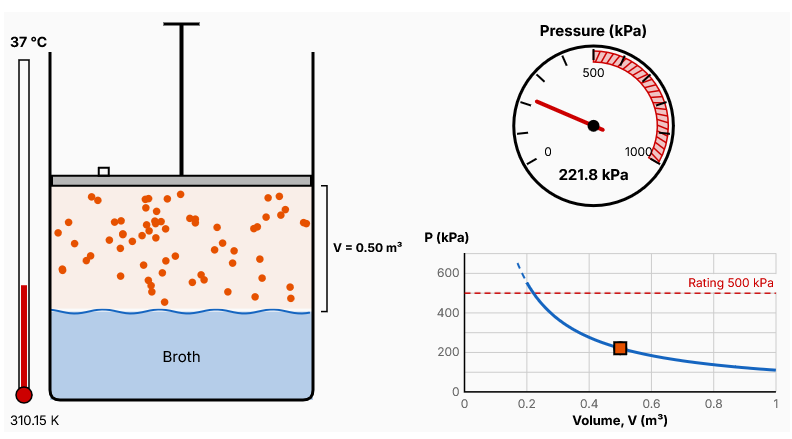
Compress, heat or add gas to a bioreactor headspace one change at a time and watch the pressure gauge; then use the full ideal gas law, with the unit conversions, to check whether the vessel stays within its pressure rating. Seven problems follow.
Start Lesson →
Lesson 2: Unit Conversion: Practice Calculations
Fifteen calculations: ten unit conversions set in biopharmaceutical engineering, followed by five workplace decisions in which the correct conversion determines the outcome.
Start Lesson →Lecture 2: Basic Thermodynamics and the First Law
Lesson 3: Heat Removal from a Bioreactor
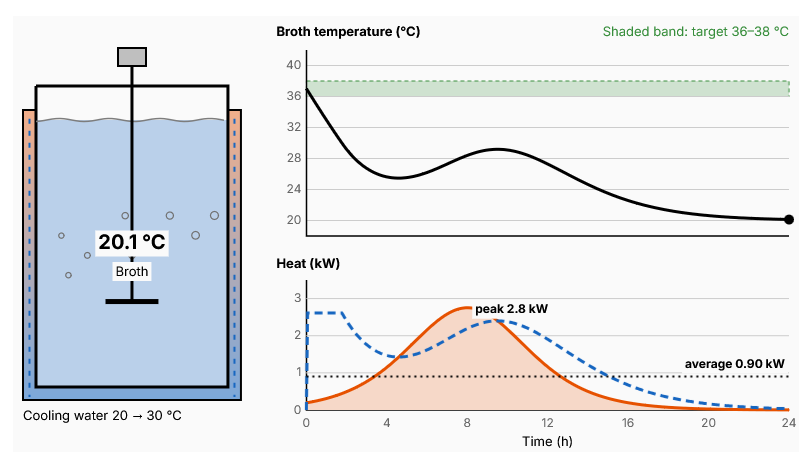
Control the cooling-water flow as the heat output of an aerobic E. coli culture rises and falls over a 24 h batch; compare a steady average flow, a steady peak flow and a flow that follows the heat; then work through the moles, heat, cooling water and flow for seven problems, including fermentation without oxygen and sizing the pump for the peak.
Start Lesson →
Lesson 4: Heat and Enthalpy Changes: Practice Calculations
Eight problems set in biopharmaceutical processing: warming media, mixing hot and cold liquids, heats of solution, dry ice in shipping, distilling water for injection and the fuel it needs. Each problem is broken into four steps, and each step is checked.
Start Lesson →Lecture 3: The Second Law, Entropy and Reaction Spontaneity
Lesson 5: Entropy and Energy Dispersal
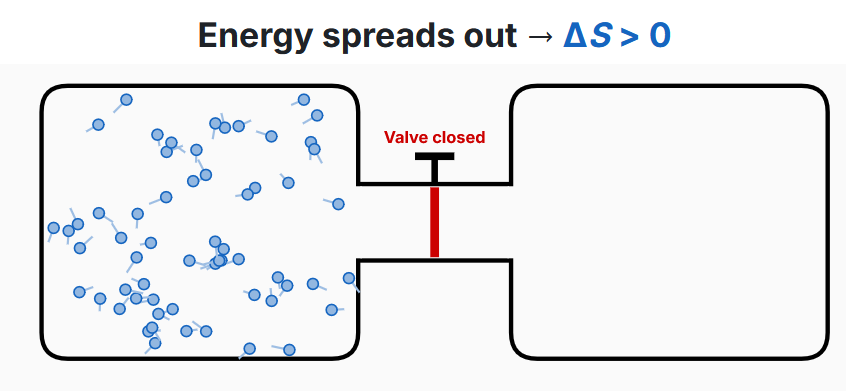
Entropy as a measure of how widely energy is dispersed. Open a valve and watch a gas spread into a second flask; compare the ways particles can move in a solid, a liquid and a gas; then see how heat passed to the surroundings counts towards the Second Law.
Start Lesson →
Lesson 6: Gibbs Free Energy and Temperature
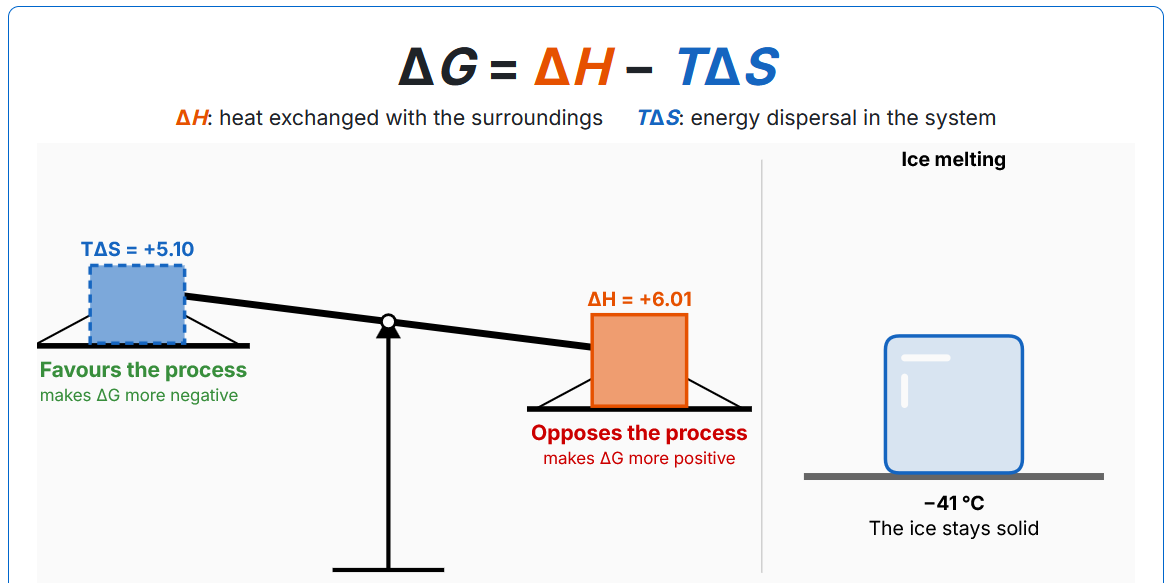
A balance weighs the enthalpy term, ΔH, against the entropy term, TΔS, for processes such as ice melting, antibody unfolding and DNA annealing in PCR. Change the temperature to find where the balance tips; then place processes in the four cases and test your knowledge with short problems.
Start Lesson →
Lesson 7: Gibbs Free Energy and Spontaneity: Practice Problems
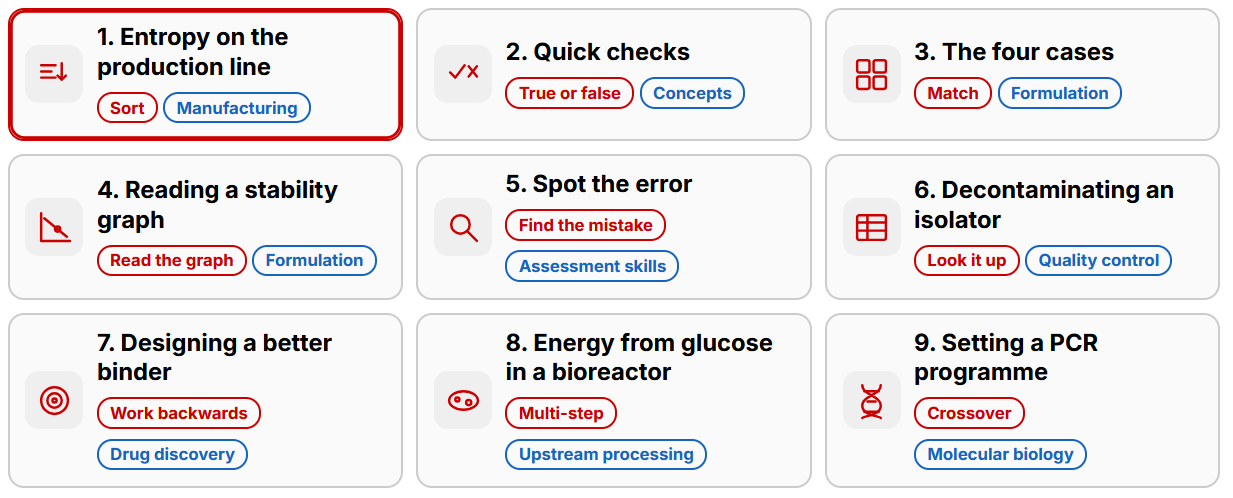
Nine problems in different formats, of the kinds set in the assessment: the sign of ΔS, true or false, the four cases, reading a stability graph, finding a mistake, calculating from CRC data (which can be hidden so that you look them up), working backwards, and multi-step bioreactor and PCR problems.
Start Lesson →Lecture 4: Feasibility of Reactions and Activation Energy
Lesson 8: Collisions, Temperature and Activation Energy
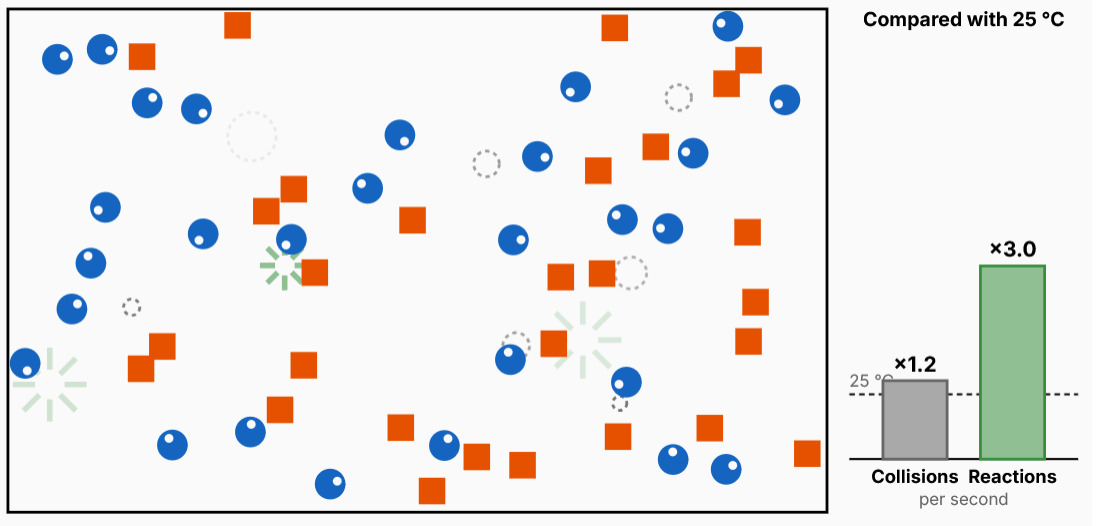
Watch molecules collide and form product, and see that only energetic, correctly oriented collisions react. Count 1,000 collisions at different temperatures to find the percentage that react; then explore the small fraction of molecules with enough energy to cross the barrier. Six decisions follow, from cold storage of antibodies to autoclaving.
Start Lesson →
Lesson 9: Spontaneity and Rate: ΔG and Activation Energy
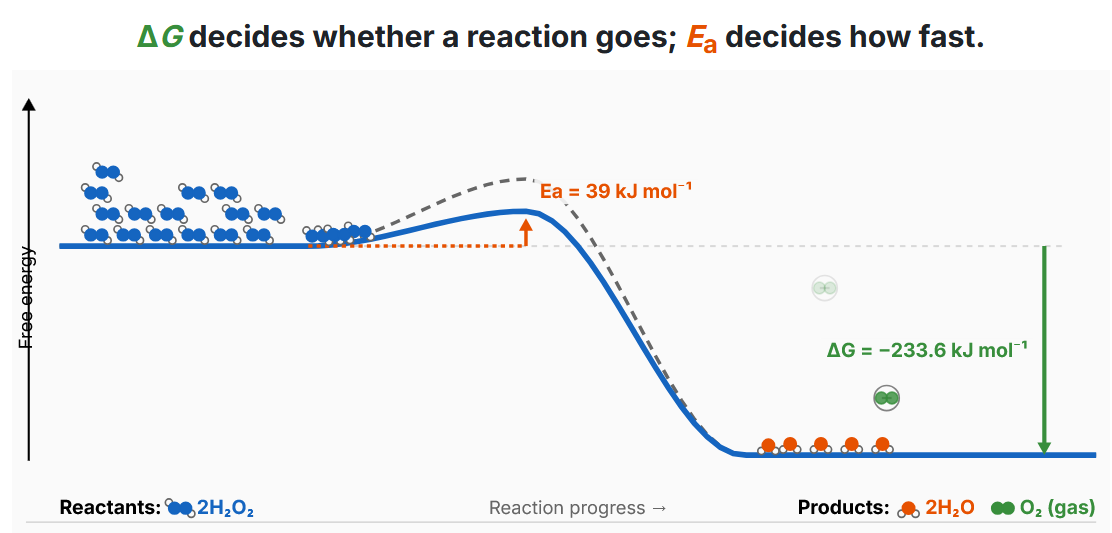
An energy profile separates whether a reaction goes (ΔG) from how fast it goes (the activation energy). Change the barrier, add a catalyst or an enzyme, and see why hydrogen peroxide keeps for months but fizzes on a wound; then choose the energy profile for six reactions and decide what each needs.
Start Lesson →
Lesson 10: Catalysts and Activation Energy
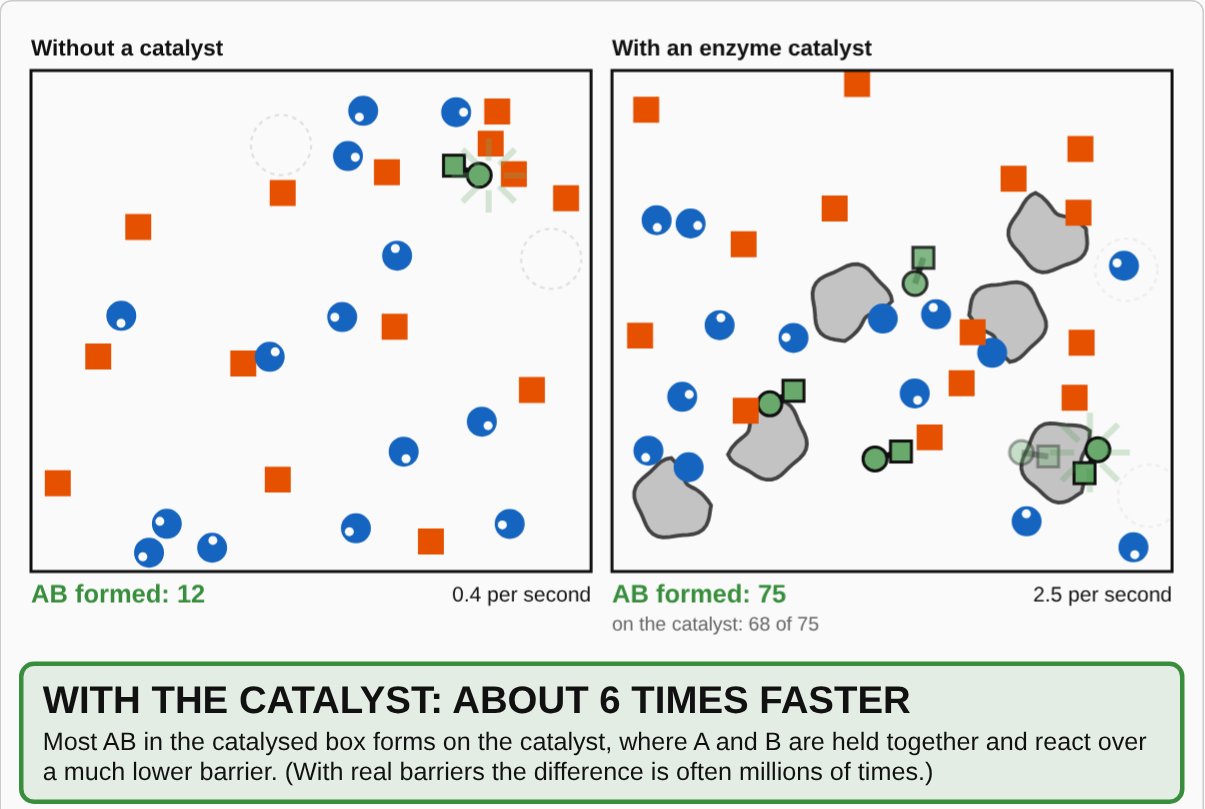
Run the same reaction side by side without and with a catalyst, either a metal surface or an enzyme, and compare the rates; heat the enzyme and watch it unfold. Then step through how the reactants bind, react over a lower barrier and leave the catalyst unchanged, beside the energy profile. Seven problems follow, from catalase to a poisoned palladium catalyst.
Start Lesson →
Lesson 11: Feasibility and Reaction Rates: Practice Problems
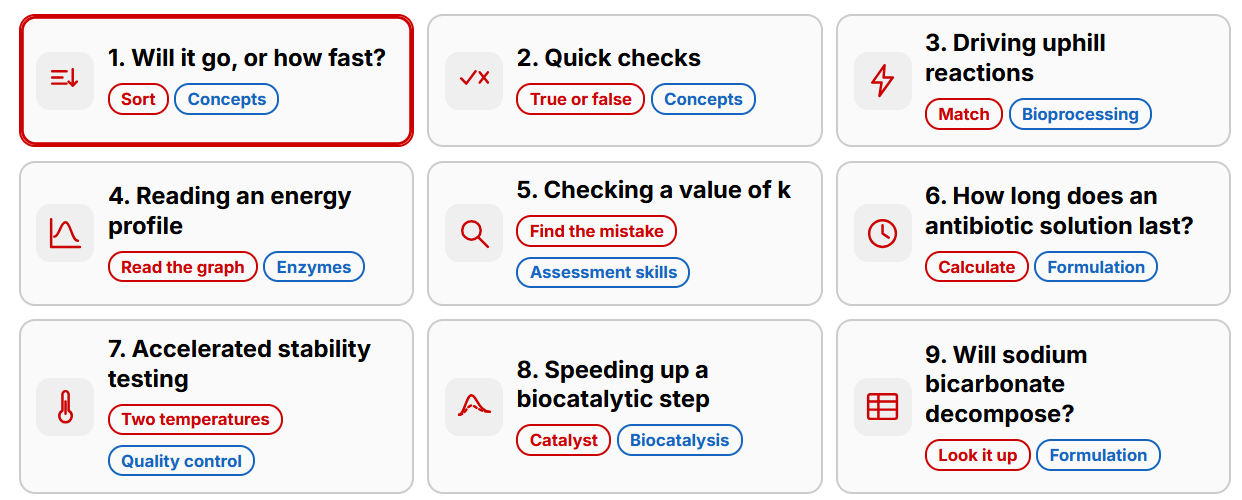
Nine problems in different formats, of the kinds set in the assessment: ΔG or rate, true or false, driving non-spontaneous reactions, reading an energy profile, finding the mistake in a value of k, half-lives, accelerated stability testing, the effect of an enzyme, and a feasibility calculation from CRC data.
Start Lesson →Refresher: Moles and Stoichiometry
The lectures assume that you can work with moles and balanced equations. If chemistry is new to you, or it has been a while, these two lessons revise the mole, molar mass and reacting masses.
Refresher: Moles and Mass Balance
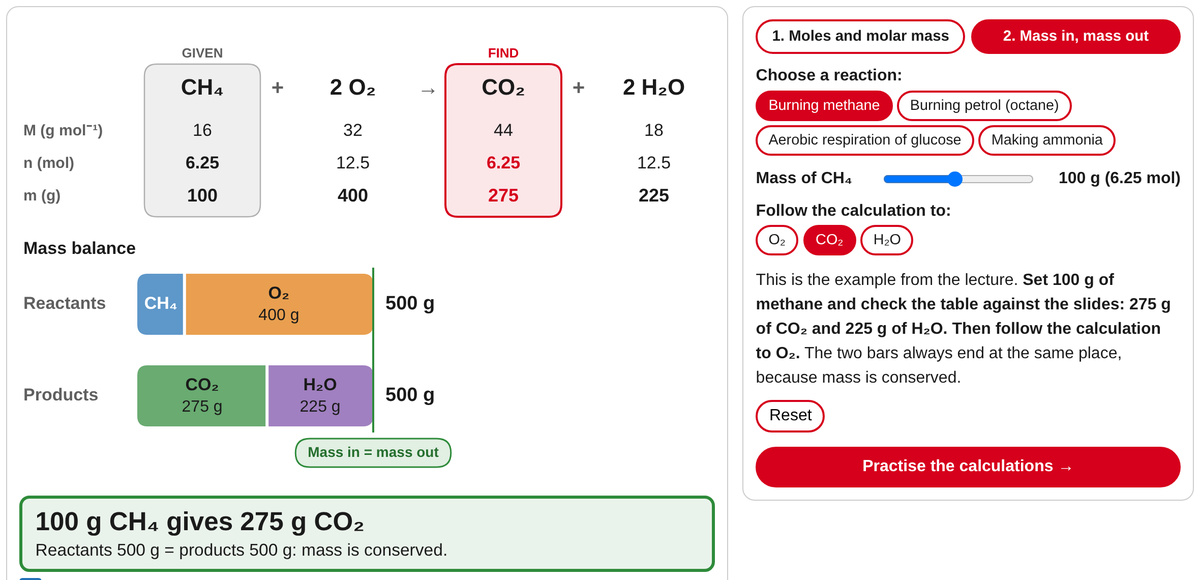
Compare the same amount of different substances, from hydrogen to glucose, and see how the molar mass is built from the atoms in the formula. Then follow a balanced equation from the mass of one substance to the masses of all the others, for burning methane and petrol, aerobic respiration of glucose and making ammonia, and see that mass is always conserved.
Start Lesson →
Refresher: Moles and Stoichiometry: Practice Problems
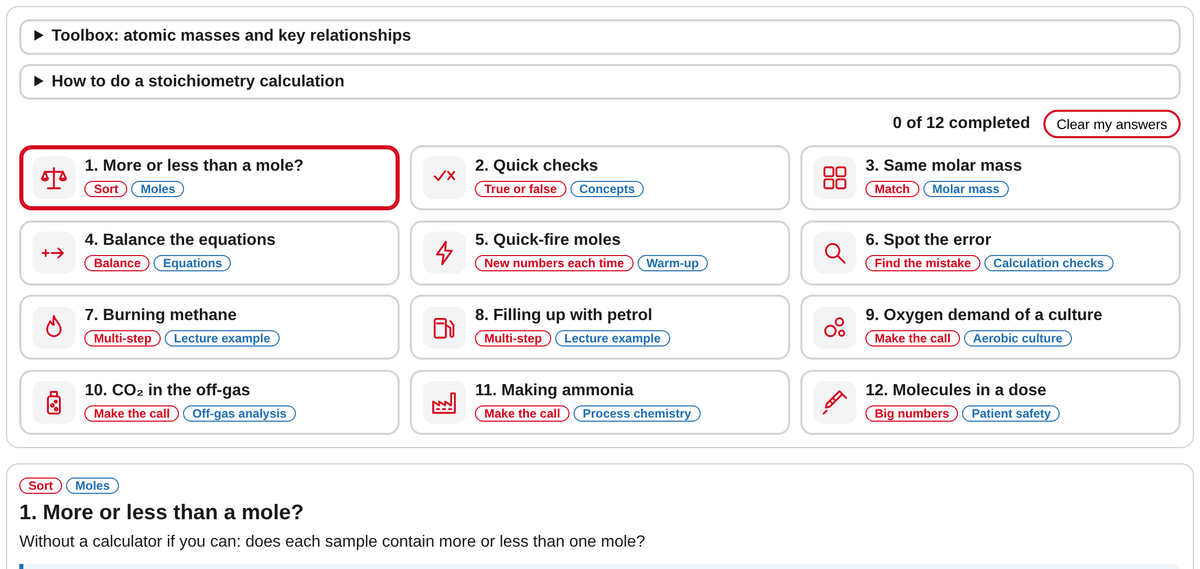
Twelve problems in different formats: more or less than a mole, true or false, matching molar masses, balancing equations, a quick-fire round with new numbers every time, finding the mistake, and multi-step problems from the lecture examples to the oxygen demand of a culture and the number of molecules in a dose.
Start Lesson →